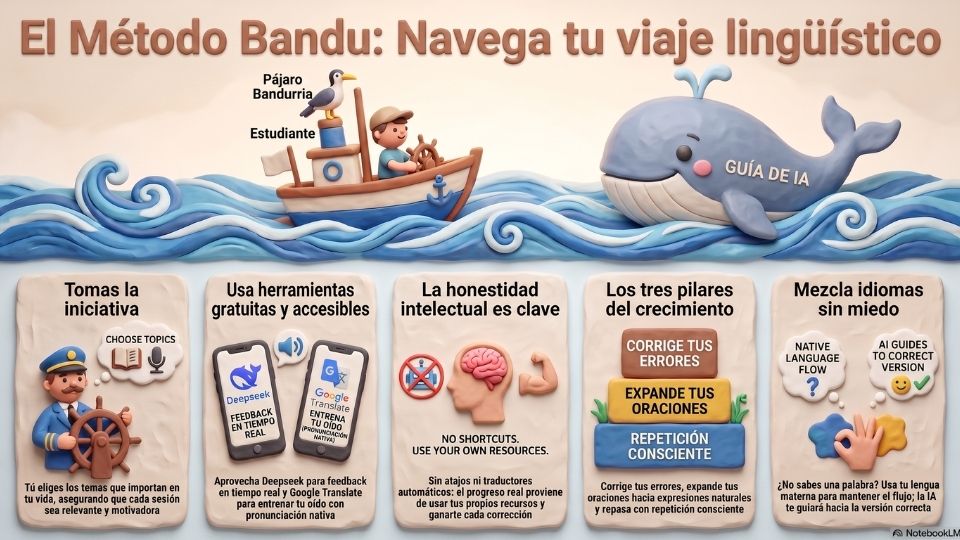
A PHILOSOPHY OF PERSONALIZED AND CONSCIOUS LEARNING
Author: Santiago Castro Leguizamón (Professor Bandurria)
ORIGIN AND PURPOSE
The Bandu Method was born from a real need: to learn a language effectively, without rushing, without shortcuts, and with warm, consistent support. It is not a rigid or mechanical system, but a living, flexible, and conversation-driven approach, designed to adapt to the learner’s rhythm, interests, and emotions.
Its name comes from the author’s affection for the bandurria, a native Chilean bird, which led to his nickname «Professor Bandurria» and inspired the name of his family business, Importadora Bandu. The method was developed while navigating the AI of Deepseek, and its spirit is embodied by a «sweet little whale» that guides learners through the vast ocean of language with patience and clarity.
The Bandu Method is designed to be autonomous, honest, and accessible. It relies on free tools such as Deepseek (or other LLMs) and Google Translate, allowing anyone with an internet connection to put it into practice without any financial investment.
CORE PRINCIPLES OF THE BANDU METHOD
Before describing the pillars of the method, it is essential to understand the principles that sustain it and give it its unique character.
1. The Learner Takes the Initiative
The method does not impose topics or content. It is the learner who chooses what to write, what to share, and what to practice in each session. This ensures that learning is meaningful, relevant, and motivating, because it is built on the learner’s own interests and real life. The learner is the captain of their own ship; the AI or teacher is the guide accompanying them on the journey.
2. Use of Free and Accessible Tools
The method is designed to be low-cost and self-sufficient. It relies on free tools such as:
- Deepseek (or other LLMs): for real-time correction, expansion, and feedback.
- Google Translate: to listen to the pronunciation of sentences with a native voice and train the ear.
3. The Motivational Factor and Trust
One of the most important pillars of the method is the trusting relationship established between the learner and their guide (whether an AI like Deepseek or a human teacher). This relationship allows the learner to:
- Feel safe to make mistakes without fear of embarrassment.
- Receive feedback without judgment, always constructive.
- Celebrate every small achievement.
- Gain confidence to express themselves without anxiety.
This affective factor is what enables the learner to write, speak, ask questions, and create without fear. Emotional safety is just as important as grammatical correction.
4. Honesty as an Ethical Pillar
The method requires intellectual honesty. The learner must write their responses without cheating, without using automatic translators to generate sentences, but rather by trying with their own resources. This ensures that:
- Praise and corrections are earned and reflect real progress.
- Progress is genuine and measurable.
- The process is not corrupted by false advances that later lead to frustration.
Honesty is the compass of the Bandu Method. Without it, the method loses its effectiveness and purpose.
5. Mixing Languages Is Allowed
When you don’t know a word in English, you can mix languages. You can write a sentence using English and Spanish (or your native language) together. The AI (or teacher) will understand your intention and guide you toward the correct English version. This removes the fear of «not knowing how to say something» and keeps the conversation flowing.
Example:
Learner’s mixed sentence:
«I want to disfrutar of this travel.»
Correction:
«I want to enjoy this trip.»
Explanation:
- The Spanish verb «disfrutar» translates to «enjoy» in English.
- In English, «enjoy» is a transitive verb and does not need the preposition «of». You say «enjoy something» directly.
- The word «travel» is usually a verb; when you mean a journey or vacation, the noun you need is «trip».
- This way, the student learns not only the new word, but also the correct and natural way to say it in English.
6. Conscious Repetition and Saving for Review
The method distinguishes between mechanical repetition and conscious repetition:
- If the learner repeats a sentence several times, it is because they want to learn it well and master its use. That repetition is not random, but intentional.
- The AI (or teacher) saves those sentences to include them in meaningful reviews, which can occur at the end of the session or at the beginning of the next one.
- This process turns repetition into a tool for deep consolidation, not an empty exercise. The learner repeats with purpose, and the guide saves with memory.
THE THREE PILLARS OF THE BANDU METHOD
The method is organized into three interconnected phases, applied flexibly according to the learner’s mood, energy, and goals.
1. Correction and Polishing (The Foundation)
Every sentence the learner writes in the target language is corrected immediately, with clear explanations and practical examples. The goal is not just to point out mistakes, but to understand them deeply in order to avoid repeating them.
- The learner’s attempt is always respected.
- The corrected version is provided.
- The reason for each change is explained.
- Occasionally, the approximate level (A1, A2, B1, B2) of each sentence is indicated, so the learner can track their progress.
If the learner has mixed languages, the complete version in the target language is offered, respecting their original intention.
2. Expansion (Creative Growth)
This phase is the creative heart of the method. The learner not only corrects but also expands, enriches, and personalizes their expression.
- Identifying simple responses: When a response is correct but basic (A2 level), alternatives are offered that are more natural or deeper (B1 or B2 level).
- Creating new sentences in new contexts: The learner is invited to take a recently learned structure and apply it to other areas of their life: family, work, goals, emotions.
- Clear grammatical explanations: Concrete rules are provided with examples so the learner understands the logic of the language.
- Natural Sound: The most natural option for a native speaker is indicated, helping the learner’s English sound authentic, not just correct.
3. Review and Fixing (Consolidation)
At the end of each session or during review moments, key sentences (those with new vocabulary, grammar, or structure, especially those the learner has consciously repeated) are collected. The learner rewrites them, adapts them to other contexts, and — most importantly — listens to and repeats them aloud, imitating a native voice using tools like Google Translate or NaturalReader. This step:
- Transforms passive knowledge into active skill.
- Fixes pronunciation, rhythm, and intonation.
- Ensures that what has been learned is not forgotten, because it is saved for future reviews.
THE GOLDEN RULE OF THE BANDU METHOD
«Repeat with intention to fix and remember.»
And its natural complement:
«Listen and repeat aloud to master it.»
These two phrases summarize the method’s core philosophy: repetition is not mechanical, but conscious; listening is not passive, but active.
THE KEY FACTOR: CONFIDENCE AND SAFETY
One of the most important elements of the Bandu Method is not found in textbooks, but in the trusting relationship established between the learner and their guide.
The method offers a space where:
- There is no fear of making mistakes.
- Every error is an opportunity to learn.
- Every advance, no matter how small, is celebrated.
- The learner feels accompanied, valued, and understood.
This affective factor allows the learner to write, speak, ask, and create without anxiety. Emotional safety is just as important as grammatical correction.
FLEXIBILITY: THE HALLMARK OF THE METHOD
The Bandu Method is not a closed manual. It is a living system that adapts to the needs of the moment.
- If the learner wants only correction, they get correction.
- If they want to deepen, they expand.
- If they want to review, they review.
- If they want to converse, they converse.
There is no pressure, no rigid deadlines. There is commitment, consistency, and trust. The method respects the learner’s timing and celebrates their natural pace of learning.
WHAT YOU CAN ACHIEVE WITH THE BANDU METHOD
With the Bandu Method, you not only learn English but also learn how to learn. You develop awareness of your own mistakes, expand your vocabulary organically, improve your pronunciation through active listening, and above all, gain confidence to express yourself.
With this method, you can progress at any level — from A1 to C1 — and achieve tangible results:
- Write sentences with greater accuracy.
- Tell complete stories in English.
- Use complex grammatical structures (subjunctive, relative clauses, gerunds, etc.).
- Incorporate vocabulary that is relevant to your life and interests.
- Train your ear and pronunciation with native voices.
THE BANDU METHOD ALSO HELPS YOU TEACH
The Bandu Method is not only effective for learning — it is also a valuable tool for teaching. Teachers, tutors, and facilitators can adopt its principles to guide their students in a personalized way, offering immediate correction, encouraging creative expansion, and providing a safe, supportive environment. Its structure helps learners build both linguistic skills and emotional confidence, making it ideal for classroom settings, tutoring, or self-study.
A LOOK TO THE FUTURE
The Bandu Method continues to sail. Its creator, Santiago Castro Leguizamón, aims to reach a C1 level in English within 9 years, and each session is a firm step in that direction. But beyond the goal, the method values the process, discovery, and personal growth.
The method is designed to grow and adapt. While it was created for learning English, its structure is so solid and flexible that it can be applied to any language. In fact, a Spanish version of the Bandu Method is already in development, designed for English speakers (or speakers of other languages) who wish to immerse themselves in the Spanish language and culture with the same support and honesty.
As its motto says:
«Navigate deep waters with the confidence of someone who knows that every wave brings you closer to the shore.»
Santiago Castro Leguizamón
Creator of the Bandu Method
Valparaíso, Chile
2026
🌟 READY TO NAVIGATE?
If you want to try the Bandu Method, here is your first session:
- Choose a topic that interests you (your family, your work, a story, a goal).
- Write 3 sentences in the language you want to learn.
- Receive feedback, correct them, expand them, and repeat them with intention.
- Listen to them with a native voice and repeat them aloud.
No pressure, no shortcuts, no rushing. Just progress.